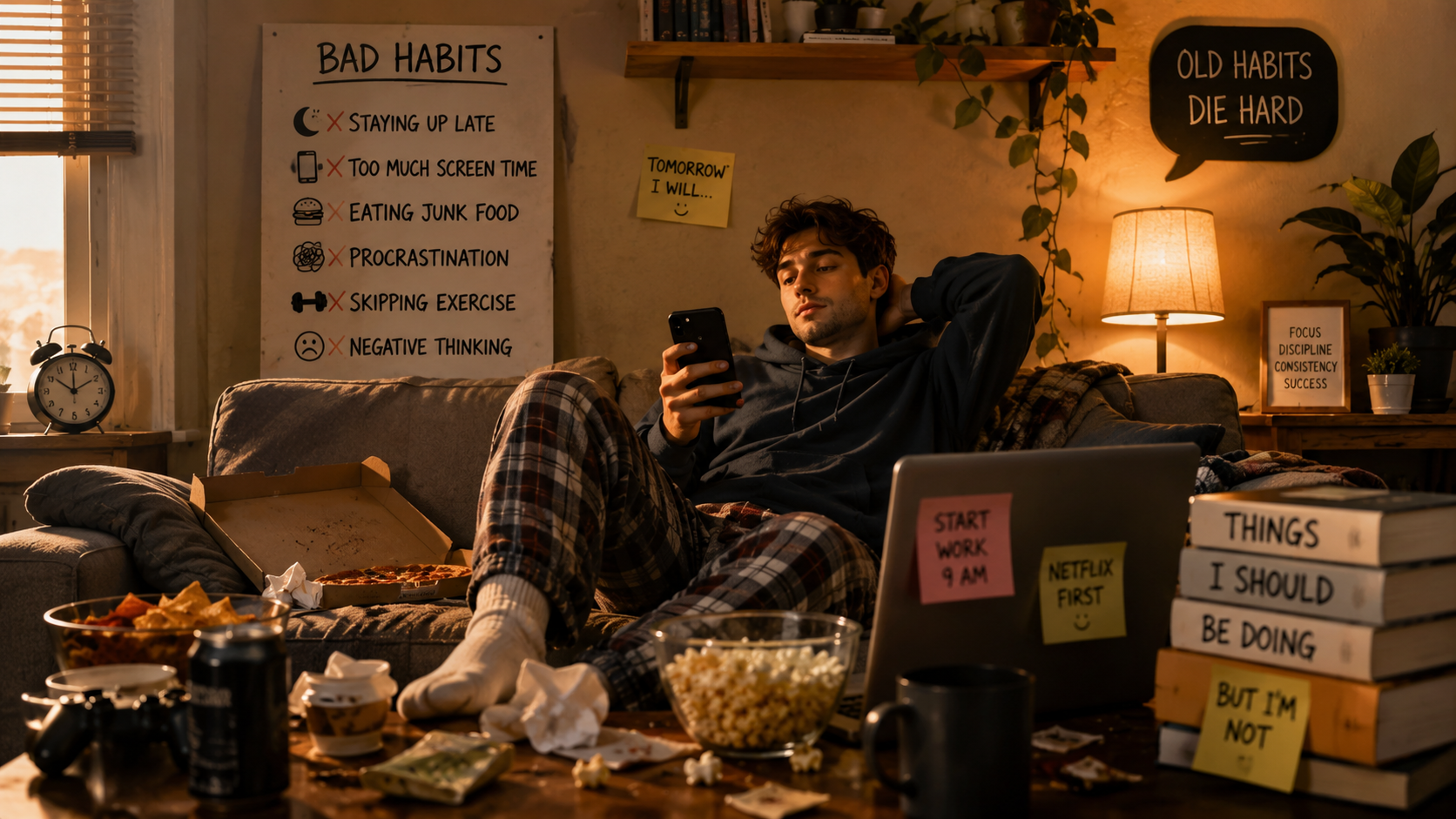
Breaking Bad Habits and Building Better Ones
A funny but thoughtful lesson about behaviour, discipline, routines, and change
This lesson starts lightly with annoying everyday habits, then moves into deeper discussion about habit loops, self-control, and realistic change. Students practise useful idioms, tense accuracy, prepositions, and natural speaking for adult conversation.
Vocabulary
Click a card to see the definition. Use Translate to show only the word or phrase in the selected language.
to stop doing a bad habit
I finally kicked my habit of checking emails in bed.
break a habit
to start doing something regularly, often without noticing
I picked up the habit of snacking while working.
fall into a habit
it is difficult to change behaviour you have had for a long time
I still reach for my phone first thing in the morning — old habits die hard.
change is difficult
to deeply irritate someone
Loud chewing really gets on my nerves.
annoy, irritate
to delay doing something you should do
I procrastinate when a task feels boring.
put off
the ability to keep doing the right thing
Discipline matters more than motivation.
self-control
doing something regularly over time
Consistency is what turns a small action into a habit.
regularity
a strong desire to do something you should avoid
My biggest temptation is scrolling before sleep.
urge
the ability to control your actions or feelings
Self-control is harder when you are tired.
willpower
a usual set of actions
A morning routine can make the day easier.
daily pattern
something that starts a habit
Stress is a trigger for many bad habits.
cue
the good feeling after a habit
The reward made the habit feel worth repeating.
benefit
to put one thing in the place of another
Replace the bad habit with a healthier action.
substitute
responsibility to someone for your actions
A friend can give you accountability.
responsibility
something you enjoy but feel a little embarrassed about
Reality TV is my guilty pleasure.
secret enjoyment
to stop a repeated negative pattern
I need to break the cycle of sleeping late.
stop the pattern
to continue following a plan
It is easier to stick to a routine when it is simple.
keep going
to give reasons for not doing something
I make excuses when I do not want to exercise.
justify
a person who likes doing the same things regularly
My dad is a creature of habit: same breakfast every day.
routine-lover
mental strength to control yourself
Willpower alone is not always enough.
determination
Reading
Read the B2 article, listen if needed, and hover over the highlighted phrases for simple definitions.
Most adults know that habits shape daily life, but changing them is rarely as simple as making a promise on Sunday night. A person may decide to sleep earlier, eat better, exercise more, or spend less time on a phone. The plan sounds sensible, yet by Wednesday the old routine often returns. This does not usually happen because people are lazy. It happens because habits are automatic patterns that the brain has practised many times.
A bad habit often begins with a small triggersomething that starts a habit. For example, stress may lead someone to check social media, boredom may lead to snacking, and tiredness may lead to skipping exercise. After the action, there is usually a quick rewardsomething pleasant you get after an action, such as comfort, distraction, or relief. Over time, the brain connects the trigger with the reward, and the behaviour starts to feel natural.
For this reason, breaking a habit is not only a question of willpowerthe ability to control yourself. Willpower can help, but it becomes weaker when people are tired, hungry, busy, or under pressure. A more effective approach is to change the environment and replaceput something new in the place of something old the unwanted behaviour with a better one. Instead of saying, “I will never check my phone at night,” someone could put the phone in another room and read two pages of a book before sleeping.
Good habits also need consistencydoing something regularly. One intense workout or one perfect morning routine is not enough. A small action repeated often is usually more powerful than a huge effort that happens once and then disappears. This is why many experts suggest starting with a goal that feels almost too easy: walk for ten minutes, prepare one healthy meal, or write one sentence in a journal.
Of course, old habits die hardold habits are difficult to change. People may make progress and then return to old behaviour for a day or two. That does not mean they have failed. It simply means they need to continue. Real change depends on accountabilitybeing responsible for your actions, patience, and a realistic plan.
Some habits are serious, but others are just annoying. Interrupting people, arriving late, leaving a mess, or checking a phone during dinner can get on someone’s nervesmake someone annoyed or irritated. These small behaviours matter because they affect relationships. In the end, building better habits is not about becoming perfect. It is about becoming more aware of daily choices and slowly creating a life that feels healthier, calmer, and more intentional.
Warm-Up: The Habit Court
No hidden dropdowns. Choose how serious each “crime” is, then explain your judgement.
Defendant #1: Checks their phone every 30 seconds during a conversation.
Defendant #2: Leaves exactly one sip of milk in the carton.
Defendant #3: Says “I’ll start on Monday” every single week.
Defendant #4: Uses speakerphone in public places.
Defendant #5: Replies “OK” to a long serious message.
Defendant #6: Chews loudly like they are testing a microphone.
Discussion
Use complete answers and give examples.
Vocabulary Check
Choose the word or phrase as used in the lesson.
1. If you “kick a habit”, you...
2. A trigger is...
3. “Old habits die hard” means...
4. If something gets on your nerves, it...
5. To procrastinate means to...
6. Consistency means...
7. A guilty pleasure is something you...
8. To replace a habit means to...
9. Willpower is...
10. A routine is...
11. Accountability means...
12. To break the cycle means to...
13. A reward is...
14. If behaviour is automatic, it happens...
15. An intentional life is one with...
Grammar: Tenses for Habits and Change
Rewrite each sentence in the correct tense. Click answers to see the tense reason.
Why: Use past simple because “yesterday” is a finished past time.
Why: Use present perfect continuous for an action that started in the past and continues now.
Why: Use present simple for a general habit.
Why: Use past continuous for an action in progress at a specific past time.
Why: Use will for promises and decisions made now.
Why: Use going to for an intention or plan.
Why: Use present perfect with “already” when the result matters now.
Why: Use past perfect for an action before another past action.
Prepositions: Multiple Choice
Choose the correct preposition in each sentence.
1. I need to cut down ___ late-night snacks.
2. She fell ___ the habit of checking her phone constantly.
3. Loud chewing gets ___ my nerves.
4. He is trying to stick ___ a simple morning routine.
5. I replaced coffee ___ herbal tea at night.
6. She blamed her tiredness ___ poor sleep habits.
7. He rewarded himself ___ a short walk after work.
8. I am accountable ___ my progress every week.
Homework
Three review tasks: finish the sentence, prepositions, and phrase choice.
Part 1: Finish the Sentence
Part 2: Different Prepositions — Drag and Drop
1. She is trying to cut down sugar.
2. He fell a bad sleeping pattern.
3. That habit really gets my nerves.
4. I want to stick my new routine.
5. Replace the snack a healthier option.
6. I blamed the problem stress.
7. Reward yourself something small.
8. Be honest your progress.
Part 3: Choose the Correct Phrase or Word
Choose the best phrase or word from the lesson. The answers are well mixed.
1. I finally ___ my habit of checking emails at midnight.
2. She ___ a new habit of walking after lunch.
3. Try to ___ the bad habit with a healthier action.
4. He always ___ when he does not want to work.
5. I need to ___ the cycle of late nights.
6. Good habits need ___.
7. Stress is my biggest ___.
8. I need more ___, not more excuses.